



Dunlop or Talalay, 2 inches or 3, latex or foam. Here’s how to pick a topper for the way you actually sleep.
If your mattress presses into your shoulders and hips, or it just isn’t the feel you want anymore, a topper can change that for far less than a new mattress. Two or three inches on top makes a surprising difference.
It won’t fix everything, and the material inside matters more than the name on the box. We make every topper on this list, so we’ll be upfront about who each one suits, what it’s made of, and when you’d be better off with something else. You’ll also find a guide to thickness, a plain list of what a topper can’t do, and why none of ours contain polyurethane foam.
Already know what you want? Browse all Avocado mattress toppers.
| Pick | Best for | What’s inside |
| Eco Organic Topper, Medium | Back and stomach sleepers who want a firmer surface on a supportive mattress | GOLS-certified organic Dunlop latex, 2″ or 3″ |
| Eco Organic Topper, Plush | Side sleepers, a mattress that feels too firm, and people who sleep warm | FSC®-certified Pure Talalay® latex, 2″ or 3″ |
| Green Hybrid Organic Topper (new) | Pressure relief with more bounce | Organic latex over microcoils, organic cotton and wool |
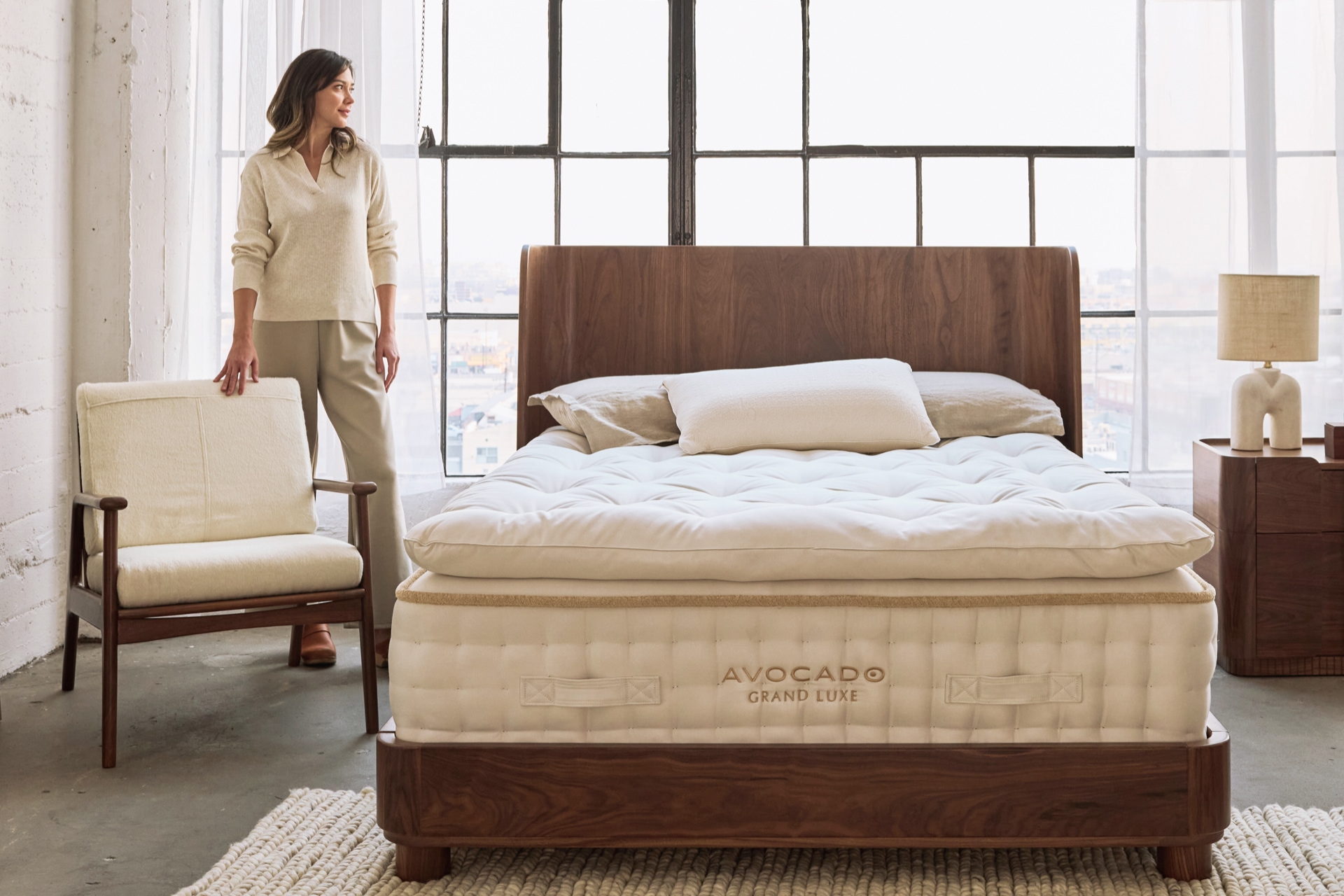
| Grand Luxe Mattress Topper | A deep, hand-tufted feel that still responds when you move | British wool ticking, Pure Talalay® latex, microcoils |
| Down Mattress Topper | People who prefer a soft, sink-in featherbed to latex | Responsibly sourced (RDS) down and feather |
Read more: Signs It’s Time to Replace Your Mattress
The Eco Organic Topper: two kinds of latex, two heights
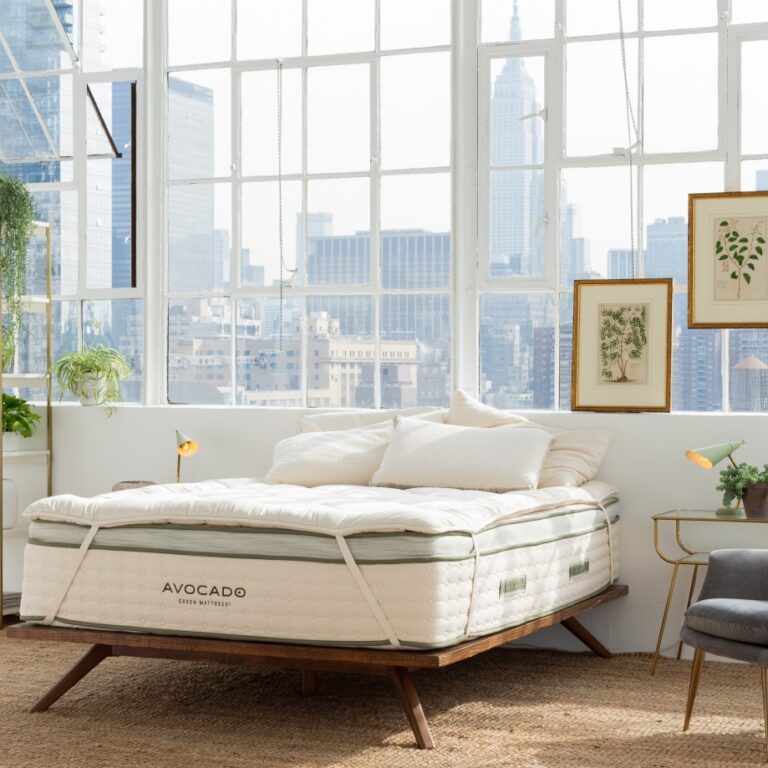
Our Eco Organic Topper is really two toppers that share a name and a cover. You choose the latex (organic Dunlop or Pure Talalay®), then the height (2 or 3 inches). The latex decides the feel. The height decides how much the feel changes. Both versions come in an organic cotton cover over a canvas base, sewn closed to protect the latex, and neither contains wool. The Eco Organic Topper has earned the Good Housekeeping Seal, awarded after evaluation by the Good Housekeeping Institute.
 Best for back and stomach sleepers who want a firmer surface
Dunlop is the denser of the two latex types we use. Press a hand into it, and it pushes back almost immediately, so you stay on top of the bed instead of sinking into it. If your mattress is still supportive but feels softer than you’d like, that resistance gives you a firmer, more lifted surface to sleep on.
The latex is GOLS-certified organic, meaning at least 95% of the latex material is certified organic. If certified-organic latex is the reason you’re shopping, this is the one to buy.
Go with 2 inches to firm up a bed you mostly like. Choose 3 inches when you want a bigger change, or if you weigh more and will compress the topper further. One practical note: Dunlop is heavy. A Queen weighs 32.5 pounds at 2 inches and 46 pounds at 3 inches, so plan on two people to put on a King.
Best for side sleepers who wake up with sore shoulders or hips
Talalay latex is made with a lighter, more open structure than Dunlop. It feels softer and springier, and it lets your shoulders and hips settle in while the rest of you stays supported. Lie on your side and you’ll notice the difference within a minute.
Our Pure Talalay® latex is FSC®-certified, which covers responsible sourcing from the rubber plantation. It is not certified organic latex, and we don’t describe it that way. It is also the airier of our two latex options, so it’s a good fit if you sleep warm.
For most side sleepers, 3 inches is the right height. A 2-inch Plush works if you’re lighter or just want to take the edge off a firm mattress.
Read more: Why Latex Mattresses Cost More
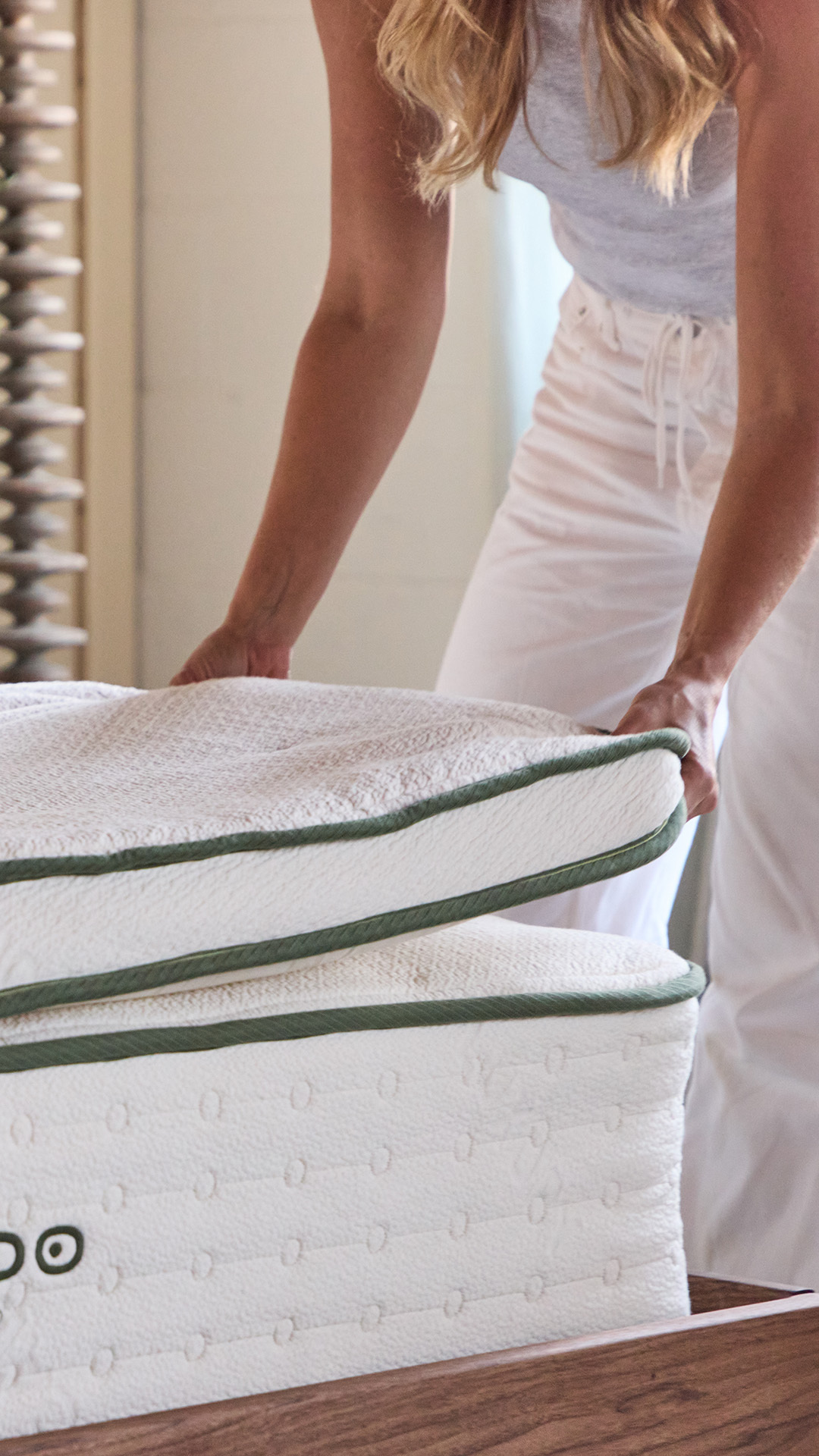 Best for sleepers who want pressure relief with more bounce
Our newest topper, the Green Hybrid Organic Mattress Topper, puts organic latex over a layer of microcoils: small springs that flex under the heaviest parts of your body and push back everywhere else. You get the contouring of latex with a springier, more lifted feel, closer to sleeping on a hybrid mattress than on a slab of latex. It’s wrapped in organic cotton and wool and is GOTS-certified at the finished-product level.
Because it contains wool, it isn’t vegan. If that matters to you, choose the Eco Organic Topper. Our Green Hybrid Mattress Topper is 3.5 inches tall and contains up to 2,756 individually-wrapped microcoils.
Read more: Why We Love Alpacas
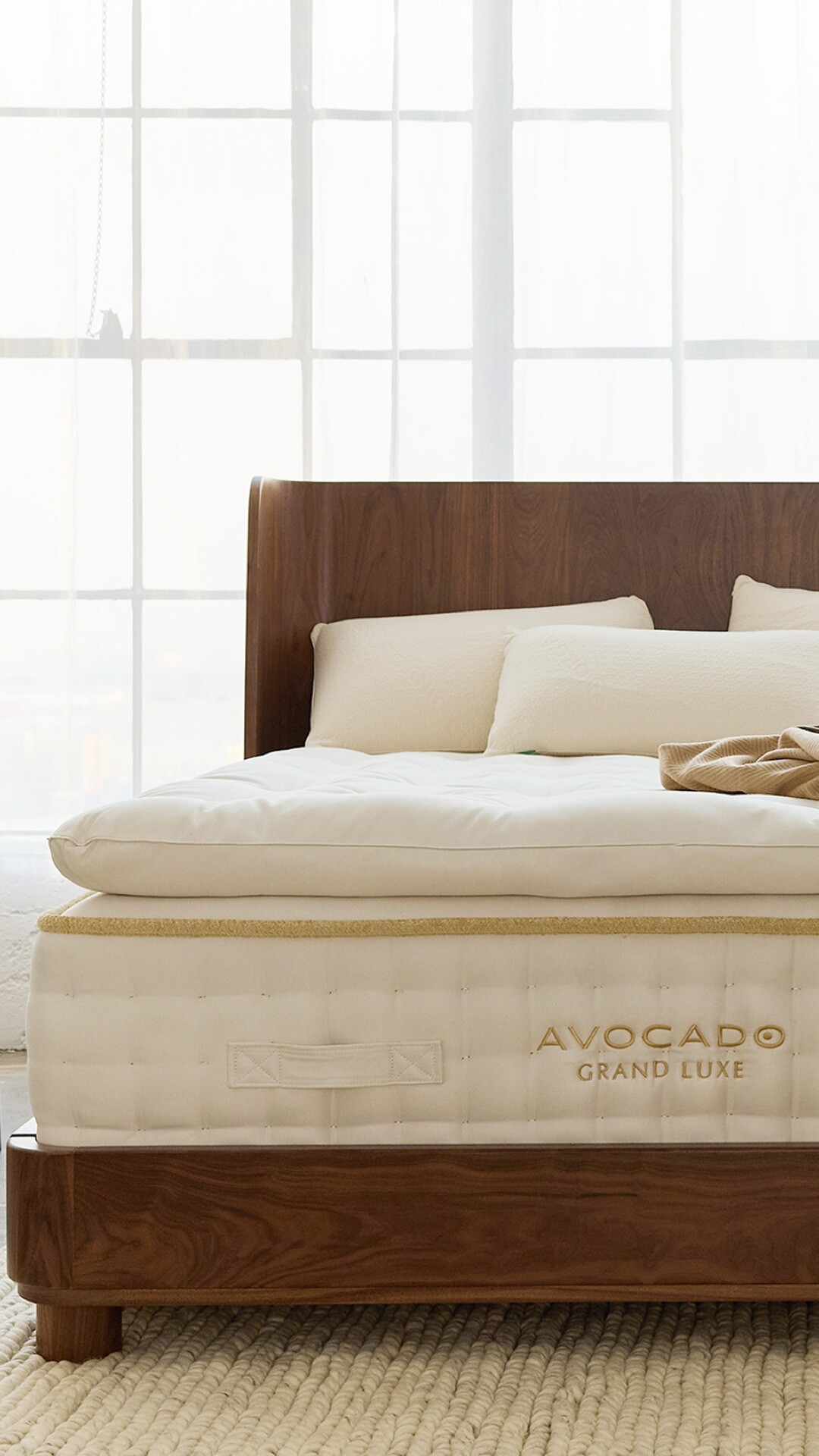 Best for anyone who wants the most layered topper we make
The Grand Luxe Mattress Topper is needle-tufted by hand in California, the same way we build our mattresses. Inside are ultra-soft Pure Talalay® latex and contouring microcoils, under a British wool ticking. The result is a deep, soft surface that still responds when you move, rather than one you sink into and have to climb out of. It’s a significant investment, and it’s built to be one. Our Grand Luxe Mattress Topper is 13.5 inches thick and contains up to 8,700 individually wrapped microcoils, arranged in three layers. It is only available in Queen, King, Cal. King and Split King sizes.
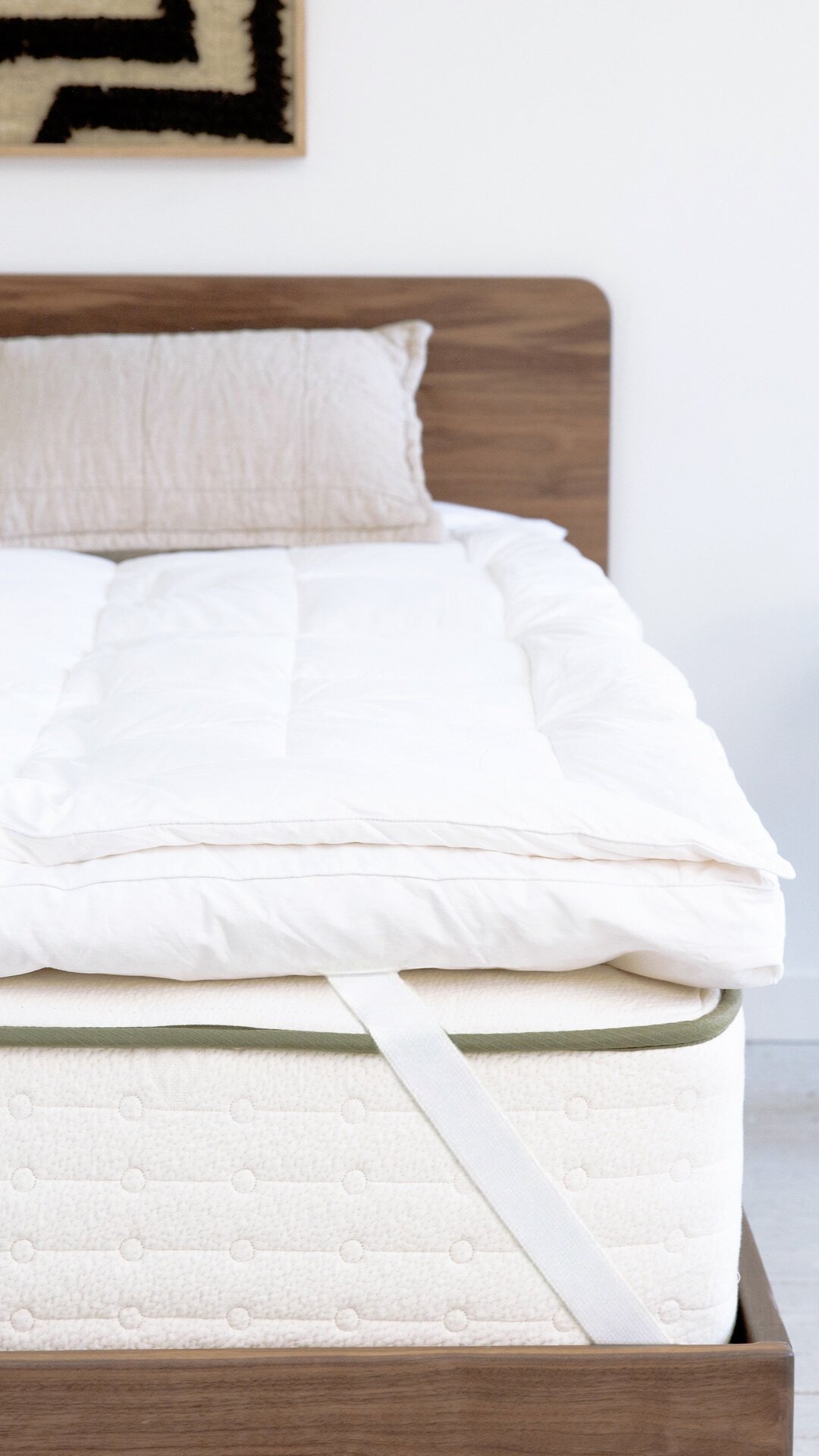 Best for people who love a traditional featherbed feel
Not everyone wants the push-back of latex. Our Down Mattress Topper is the soft, packable alternative: down and feather that gives way under you like a featherbed. The down is certified to the Responsible Down Standard (RDS), and the topper is OEKO-TEX® certified.
It’s a different kind of product from everything above, and it comes with trade-offs. Down compresses over time and needs more upkeep than latex. Because it contains down, it isn’t GOTS-certified and isn’t vegan.
How to choose a mattress topper
Start with what’s wrong with your bed now, not with the topper. Too firm and you want cushioning, so look at Plush latex or down. If it’s too soft and you want a firmer surface, look for Medium, provided the mattress underneath is still supportive. Then choose a height based on how big a change you’re after.
How thick should a mattress topper be? A 2-inch topper fine-tunes the surface of a bed you mostly like. A 3-inch topper changes the feel noticeably. Heavier sleepers press further into any topper, so they usually do better with 3 inches. Your sleep position matters too, since it changes where you need the cushioning:
| Under 130 lb | 130-230 lb | Over 230 lb | |
| Side sleeper | 2 – 3″ | 3″ | 3″ |
| Back sleeper | 2″ | 2 – 3″ | 3″ |
| Stomach sleeper | 2″ | 2″ | 2 – 3″ |
Treat this as a starting point, and choose firmness along with thickness. If you sleep on your stomach and go up to 3 inches, stay with Medium, because a thick, soft layer lets the hips dip. The right combination is whichever one keeps your spine closest to straight when you lie down.
By sleep position. Side sleepers carry their weight at the shoulders and hips, so they need a softer, thicker layer: the 3-inch Plush is our usual recommendation. Back sleepers need even support from head to heels, and either latex works depending on your mattress. Stomach sleepers should stay thinner and firmer, because a soft topper lets the hips dip and arches the lower back. A 2-inch Medium is the safer choice.
Buying for a dorm? Most dorm beds are Twin XL: the same 38-inch width as a Twin, but 5 inches longer. A Twin topper will leave the foot of the bed bare, so order Twin XL unless the school tells you otherwise.
What a topper can and can’t do
A topper changes the surface of your bed. It doesn’t change what’s underneath, and most disappointment with toppers comes from expecting it to.
A good topper can:
- Soften a mattress that feels too hard, without touching the support below it.
- Add some firmness to a bed that has softened, as long as the mattress itself is still structurally sound.
- Relieve pressure at the shoulders and hips, where side sleepers carry most of their weight.
- Keep a supportive mattress comfortable longer, which can delay the cost (and the landfill trip) of replacing it.
A topper can’t:
- Fix a sagging mattress. If the core has broken down and there’s a dip you can see, a topper will settle right into it. At that point, you need a new mattress, not another layer.
- Make a very soft bed truly firm. It can firm up the surface, but support comes from the mattress below.
- Stand in for a mattress protector. Most toppers, including ours, are spot-clean only, so put a washable mattress protector over it.
A few practical things to expect, too. Your bed will be 2 to 3 inches taller, so you may need deep-pocket fitted sheets, which also help hold the topper in place. Latex toppers are heavy, so plan to unbox and position one with help. Rotate yours head to foot every few months, so it wears evenly.
Why we don’t use polyurethane foam
Memory foam is a type of polyurethane foam, made mostly from petroleum-derived chemicals. Many brands build their toppers from it. None of ours contain it, or any other polyurethane foam, for three reasons.
The first is what it’s made from. Latex starts as sap tapped from rubber trees. Because it’s a farmed material, latex can be certified organic (to GOLS), and a finished topper can be certified organic too (to GOTS). Polyurethane is synthetic, so it can’t be certified organic.
The second is how it feels overnight. Memory foam softens with body heat and molds slowly around you, then holds that shape. Some people love that. It also tends to hold heat and can make it harder to roll over. Latex supports you closer to the surface and springs back as soon as you move.
The third is resilience. Latex springs back every time it’s compressed, which is a large part of why it holds its shape well. How long any topper lasts still depends on its density, its construction, and how it’s cared for.
To be fair to foam: if you want a deep, slow, enveloping contour, memory foam does that better than latex. If you want responsive support that breathes, latex is the better match. For a side-by-side comparison, see Mattress Toppers: Organic Latex vs. Memory Foam.
Common Questions
What’s the difference between Dunlop and Talalay latex? Both come from rubber tree sap, but they’re processed differently. Dunlop comes out denser and feels firmer and more grounded. Talalay has a lighter, more open structure, so it feels softer and springier. In our Eco Organic Topper, Dunlop is the Medium option, and Talalay is the Plush.
Is the Plush topper organic? The Pure Talalay® latex in the Plush is FSC®-certified, not certified organic. The Medium uses GOLS-certified organic Dunlop latex. If certified-organic latex is your priority, choose Medium.
What makes a mattress topper non-toxic? “Non-toxic” has no legal definition, so look for third-party certifications on the finished topper rather than on one material inside it. Ask any brand, including us, which certifications cover the product as it arrives at your door. The finished Eco Organic Topper holds GOTS, OEKO-TEX® Standard 100 Class I, MADE SAFE®, EWG Verified®, GREENGUARD Gold, UL® Formaldehyde-Free, and Certified Vegan.
Do latex toppers sleep hot? Latex is more breathable than memory foam, which tends to hold heat. Of our two latex options, the Plush Talalay is the airier one.
How long does a latex topper last? It depends on the latex, the topper’s construction, and how you care for it. Latex is resilient and tends to hold its shape well, while down compresses more quickly. A washable protector, rotating it head to foot every few months, and spot-cleaning instead of soaking all help it last.
Can I put a topper on any mattress? Yes, as long as the mattress is still supportive. A topper changes the surface, so it works on innerspring, hybrid, latex, or foam beds. It won’t correct a mattress that has already sagged.
How do I keep a topper from sliding? Put it directly on the mattress and cover both with a deep-pocket fitted sheet or a fitted mattress protector. Latex has a natural grip and tends to shift less than slick foam.
Can you wash a mattress topper? Not in a machine. Spot-clean with mild soap and water, blot rather than rub, and let it air-dry completely. A washable protector over the topper is the easiest way to keep it clean.
Is a mattress topper worth it? It is when your mattress is still supportive, but the surface feels too firm or too soft, because it changes the feel for far less than a new bed. It isn’t when the mattress has sagged or broken down. Then a topper only hides the problem for a while.
Still deciding? Compare all Avocado mattress toppers side by side, including organic latex, microcoil hybrid, and down options.
Read more: The Best Fabrics For Deep Sleep
Have feedback on our story? Email [email protected] to let us know what you think!
Shop Pillows
The Essential Organic Pillow Collection
Gentle, breathable, non-toxic support.